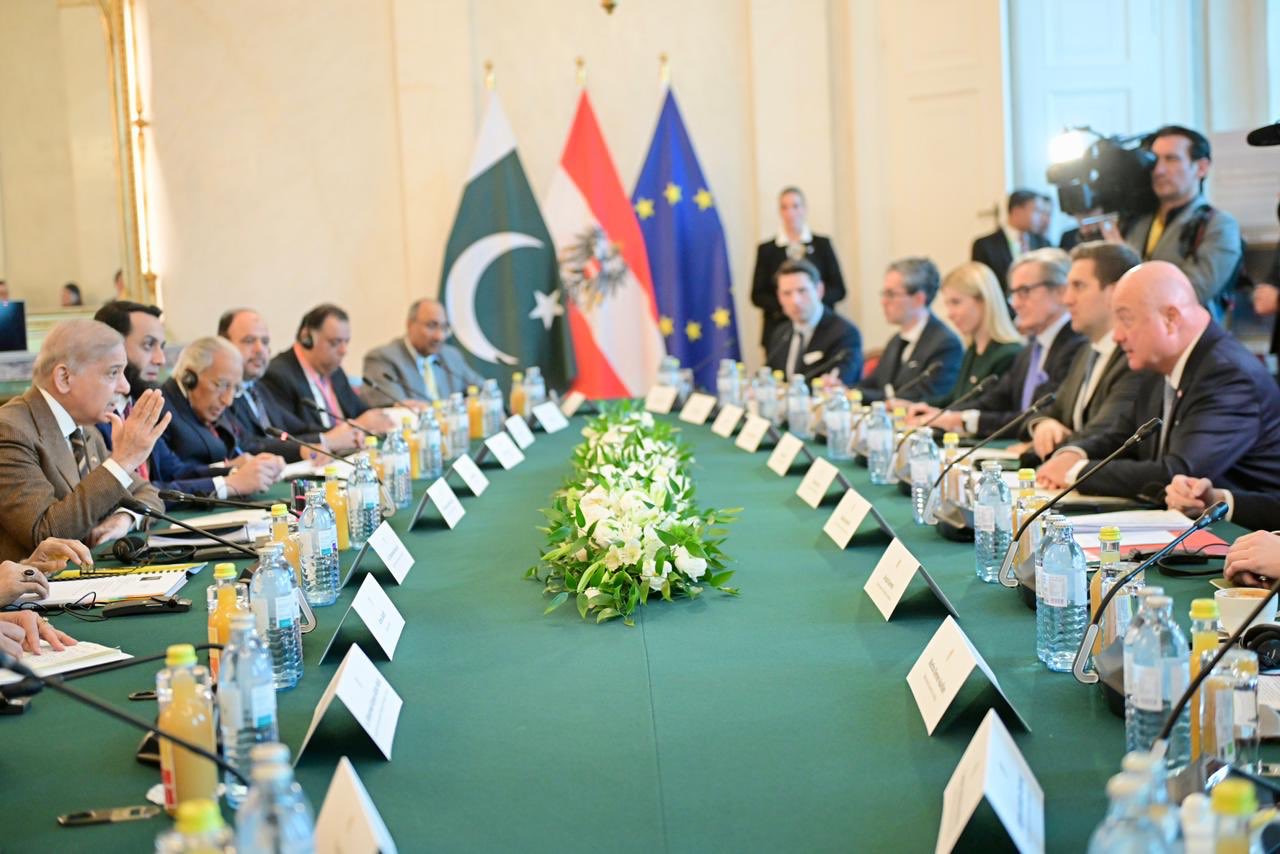
Prime Minister Shehbaz Sharif landed in Vienna on February 15 as part of a welcoming reception hosted by the country’s chancellor, Christian Stocker, to kick off a visit encouraging closer commercial and environmental cooperation between Pakistan and Austria.
Founded 70 years ago, the Austrian Federal Economic Chamber hosts a permanent delegation in Karachi, representing domestic businesses operating in Pakistan and the Gulf states. As a result, Austrians are well-accustomed to Pakistan’s renowned textiles, primarily importing house linens and non-knit suits.
One of the primary goals of the Prime Minister’s visit was to invite Austrian energy companies to invest in Pakistan. The Austrian petrochemical company OMV (Österreichische Mineralölverwaltung Aktiengesellschaft) previously operated exploration and extraction sites in the country before selling its local assets in 2018. Today, the prime minister’s visit is focused on hydroelectricity, as Pakistan seeks to expand upon its substantive renewable energy capacity.
Preexisting business ties notwithstanding, Austria is a natural partner for hydroelectric capabilities. Like Pakistan, Austria is crisscrossed by mountains and river valleys, along which its main population centers are based. This is both the perfect situation for robust hydroelectric networks, but also presents dangers in the form of flooding, necessitating careful water management.
Austria currently derives 60 percent of its electricity from its array of water turbines along the Danube, and aims to expand its reach to 100 percent renewable energy production by 2030. Currently, 30 percent of Pakistan’s power comes from hydroelectric facilities, though the Energy Ministry estimates they have only harnessed 16 percent of their potential output.
After the first round of meetings, the two leaders attended a United Nations Special Event on Sustainable Development hosted in Vienna, where the Prime Minister spoke on the unique environmental challenges Pakistan is facing. He condemned the use of water as a weapon, referring to India’s unilateral suspension of the Indus Water Treaty and stated plans to block the flow of cross-border rivers.
He also touched on Pakistan’s young population, which presents both a crisis and an opportunity. With one of the youngest median ages of any country, the government needs to conserve its natural resources in order to support millions of young Pakistanis as they age. He argued that these youths, as well as people from marginalized communities, must be included in any discussion that proposes solutions for the climate crisis.
The visit to Austria is the latest in the prime minister’s recent string of meetings with foreign leaders. Two weeks ago, he hosted the president of Uzbekistan in Islamabad, and on Thursday, he attended the first meeting of the Board of Peace in Washington, D.C.