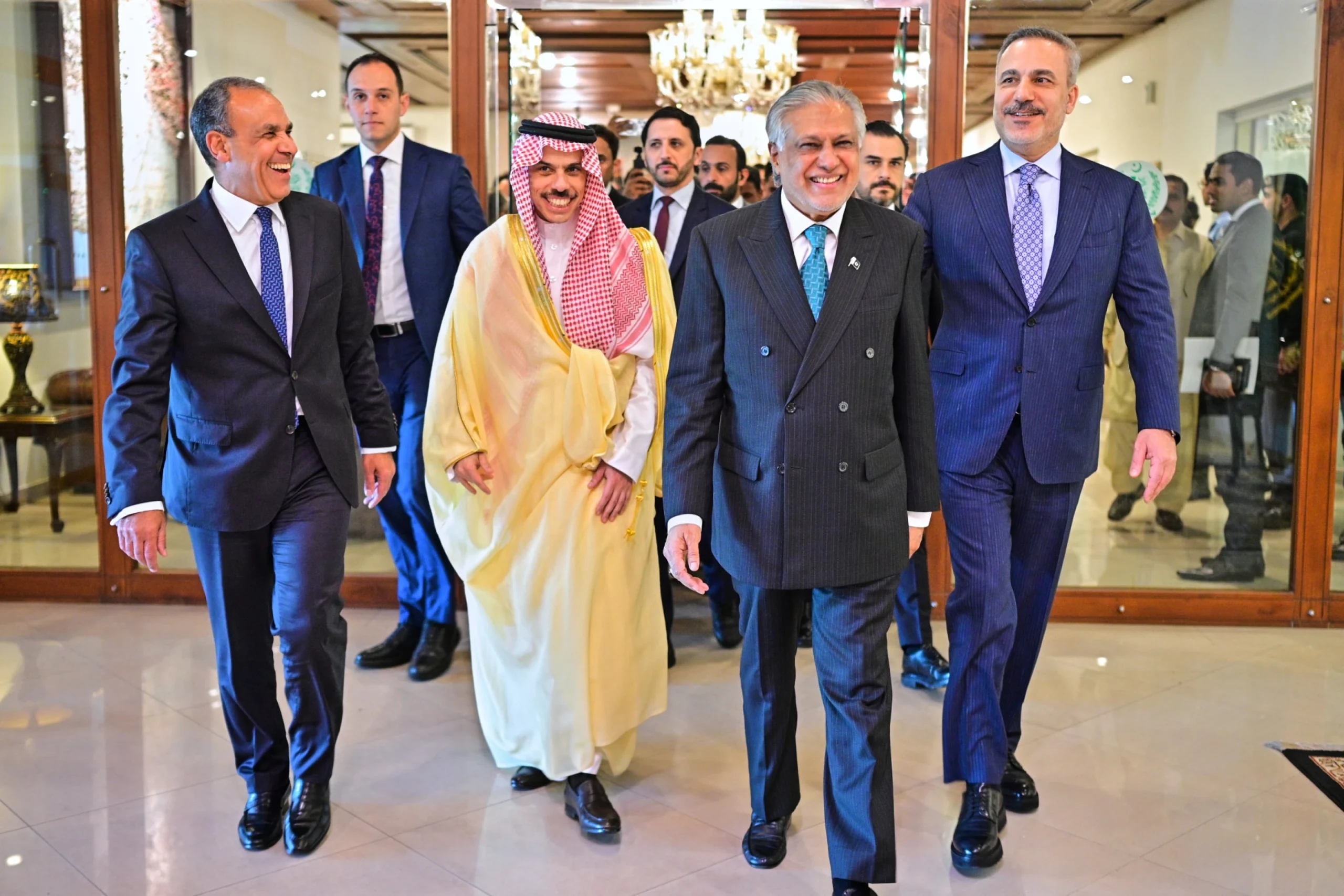
Pakistani Foreign Minister Ishaq Dar confirmed that his country will soon host talks between the United States and Iran “in the coming days,” following a peacemaking summit in Islamabad where he welcomed the foreign ministers of Turkey, Egypt, and Saudi Arabia.
The Islamabad summit, held to coincide with the 30-day mark of hostilities between the United States, Israel, and Iran, focused on developing methods to deescalate the conflict and bring the parties involved to the negotiating table.
Pakistan, Turkey, and Saudi Arabia have coordinated closely in the past few months, following rumors of Turkey seeking entry into the Strategic Mutual Defense Agreement forged between Pakistan and Saudi Arabia last year. The hypothetical alliance, dubbed the “Islamic NATO” by analysts, could revolutionize Middle Eastern geopolitics if realized—and would greatly boost Pakistan’s standing as a regional actor.
Of the parties involved, Pakistan is in a uniquely beneficial position to host US–Iran talks as the country lacks the animosity of Saudi–Iran relations, and the complications of Turkey’s NATO membership, which Iran could interpret as pro-US bias. Pakistan is also one of the few countries with developed, stable diplomatic relations with both the US and Iran.
Dar announced a diplomatic breakthrough Saturday, March 28: Iran will allow twenty Pakistani-flagged ships to transit the Strait of Hormuz, with two making the passage each day. In a moment where the Strait’s traffic has fallen to a fraction of pre-conflict levels due to fear of attack, Iran’s decision to allow Pakistani vessels to cross safely signals its willingness to accept Pakistan as a mediating party.
The development demonstrates the government’s hopes to reassert Pakistan’s historic peacemaking role and ease current global humanitarian and economic burden.