From November 12-13, Harvard University and Boston University welcomed Ambassador Rizwan Saeed Sheikh for wide-ranging discussions on Pakistan-U.S. relations and on how the Pakistani diaspora in the United States is key to the bilateral relationship.
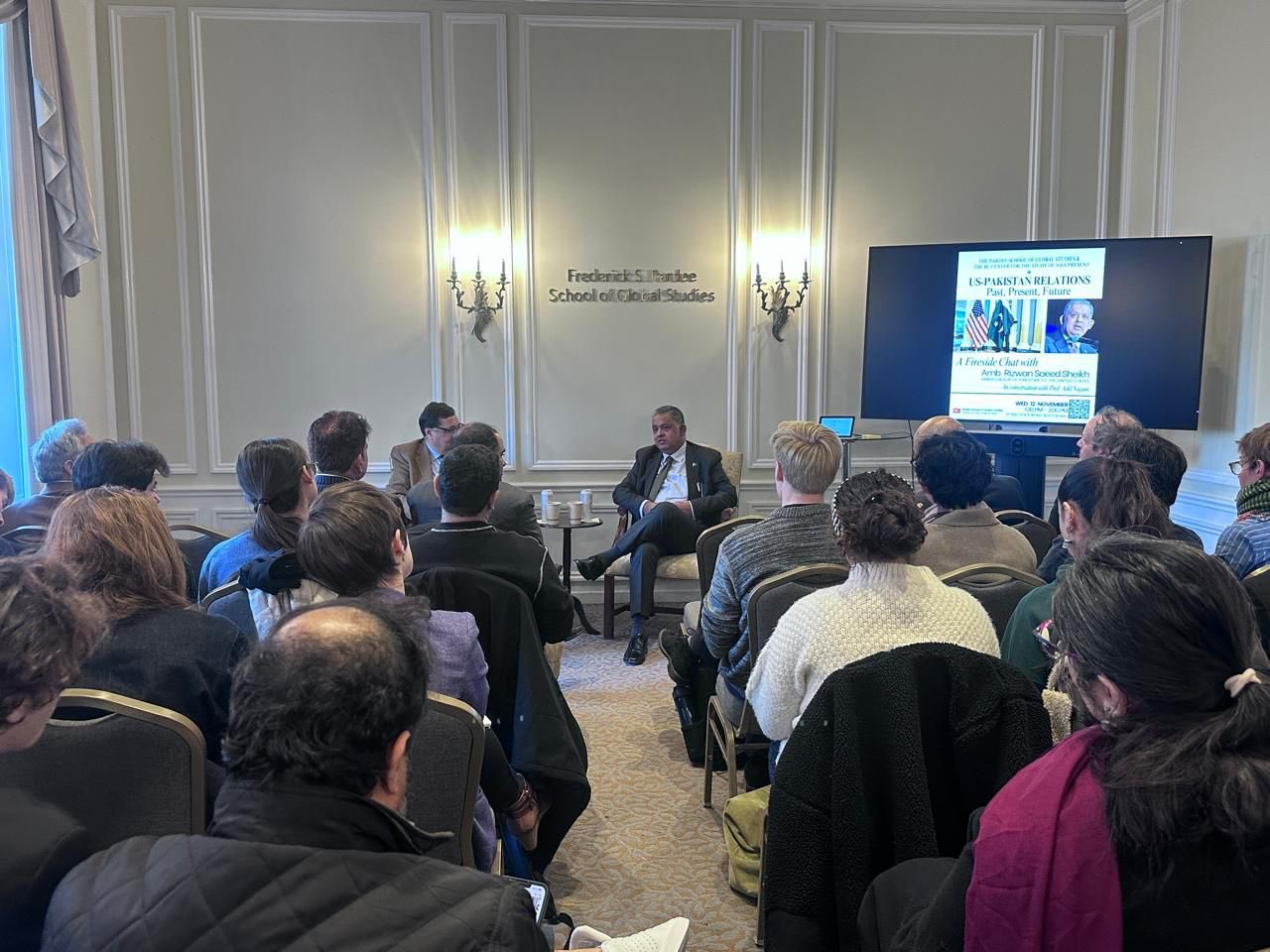
Boston University’s Frederick S. Pardee School of Global Studies’ Center for Asian Studies organized an event moderated by Professor Adil Najam, Dean Emeritus of the Pardee School. The event attracted a diverse audience of academics, diplomats, and prominent geopolitical analysts and experts.
“Good bilateral relations between the two mega countries of today and tomorrow are not optional. It is an imperative. It’s indispensable,” said Ambassador Saeed Sheikh.
During his remarks at Boston University, the Ambassador acknowledged that historically the Pakistan-U.S. relationship revolved around security manners but is now evolving as, “the United States is looking at a strategic partnership with Pakistan entrenched in economic relations.”
The Ambassador went on to remark upon Pakistan’s various economic opportunities for the United States, including its mineral resources and youthful talent. Pakistan has the potential to be a major economic hub thanks to its connectivity, which could effectively meet the needs of Central and West Asia, as well as the Middle East, and into Africa.
In discussing the 88-hour crisis in May 2025, Ambassador Rizwan Saeed Sheikh acknowledged U.S. President Donald Trump’s key role in facilitating a ceasefire. The Ambassador made clear that meditated engagement between Pakistan and India could enable economic development that would uplift millions of people from poverty in South Asia.
Ultimately, the Ambassador shared his hope that, “We can work together as an international community for shared interests.”
Then at Harvard, Ambassador Rizwan Saeed Sheikh was welcomed by the Pakistan Student Association (PSA) at the Harvard Graduate School of Education. In his remarks, the Ambassador called upon the next generation of Pakistani American leaders to serve as enduring bridges between the two nations and help to create economic empowerment through emerging technologies and to embrace strategic partnerships which benefit foreign relations.
At Harvard, the discussion centered around new technologies, foreign policy, and building upon the longstanding ties between Pakistan and the United States. Apart from Harvard students, Pakistani diaspora professionals, and dignitaries were also in attendance. Pakistan’s Consul General in New York, Amar Ahmed Atozai attended the event.
Ambassador Rizwan Saeed Sheikh described the US-Pakistan relationship as “as old as Pakistan itself.” He went on to call for young Pakistani-Americans to honor their heritage and, “Invite people to profit from the promise of Pakistan.”
The Ambassador noted that Pakistan’s government is taking steps to become a major AI hub, by providing the necessary infrastructure for the industry to attract and empower young professionals. As one of the top freelancing countries in the world, Ambassador Rizwan Saeed Sheikh highlighted Pakistan’s workforce as key to its future growth and success.
Ultimately, the Ambassador called diaspora attendees the “Permanent ambassadors of the country,” to strengthen relations between Pakistan and the United States.
Pictured: Ambassador Rizwan Saeed Sheikh at Boston University’s Frederick S. Pardee School of Global Studies’ Center for Asian Studies (Courtesy: Embassy of Pakistan USA X)