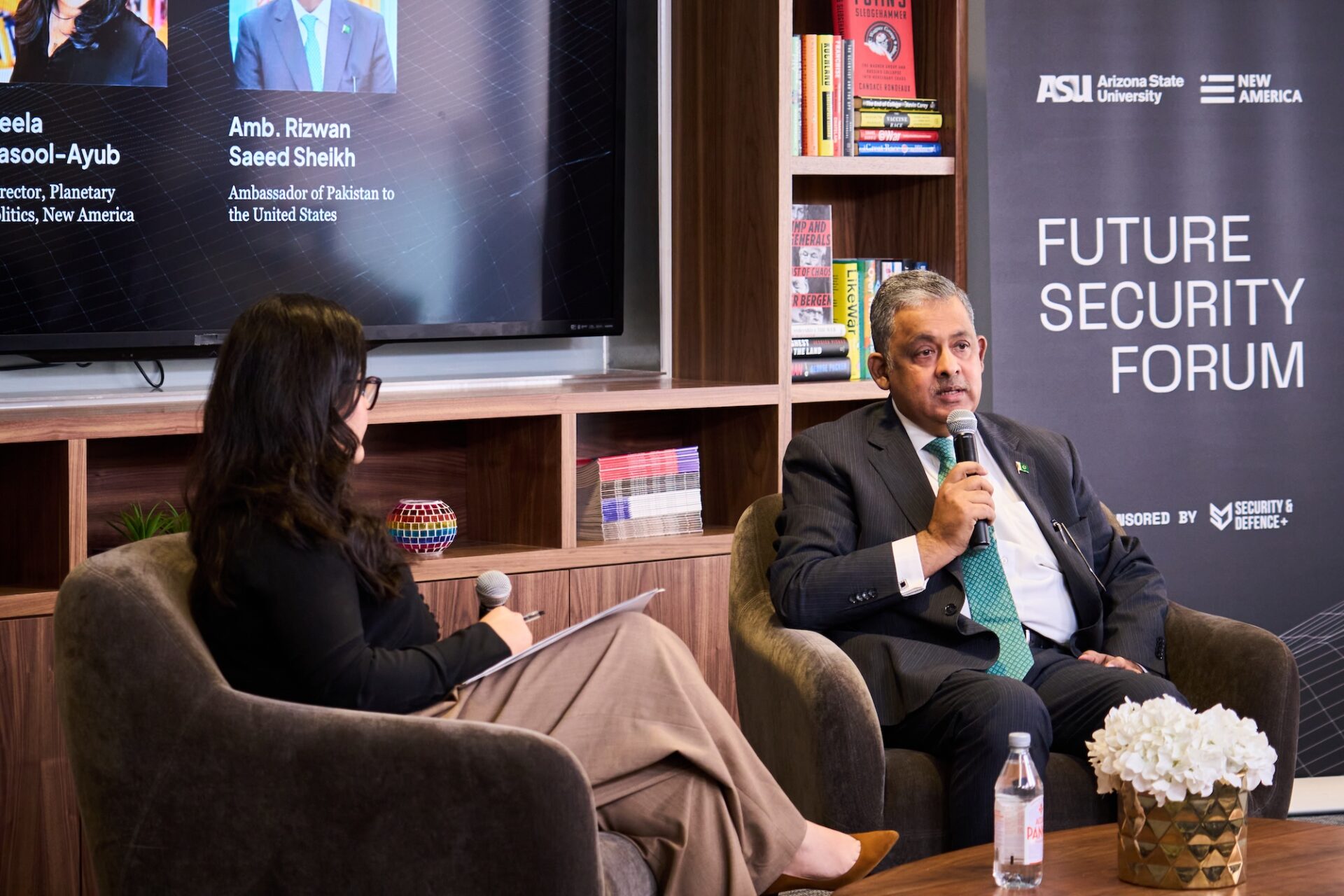
On October 22, the policy think tank New America and Arizona State University’s Future Security Initiative hosted the eleventh annual Future Security Forum in Washington, D.C., inviting experts and policymakers to speak on threats to global security.
The conference focused not only on military and diplomatic challenges, but also potential implications of further advancement in A.I. technology, and the challenge of global food security.
Speaking in a panel discussion “The Future of the U.S.-Pakistan Relationship,” Pakistan’s Ambassador Rizwan Saeed Sheikh thanked U.S. President Donald Trump for his role in brokering a ceasefire during the four-day conflict between India and Pakistan last May.
Elaborating on India-Pakistan relations, the Ambassador reiterated calls for international arbitration on the status of “Indian Illegally Occupied Jammu and Kashmir,” to “realize [the Kashmiri people’s] right to self-determination.” In any case, he renounced the idea of resolving disputes with India – or the ongoing conflict with Afghanistan – through violence: “Diplomacy is our preference. Pakistan’s history shows we have always stood for diplomatic solutions.”
On wider matters of diplomacy, the Ambassador rejected any notion of Pakistan’s close relationship with China being contradictory with its stance of seeking closer ties with the United States. Rejecting “camp politics” and “binary choices,” he stated that Pakistan desires a pragmatic foreign policy strategy, and that China’s substantial investments in the country, such as the China-Pakistan Economic Corridor, should be viewed through the lenses of economic stability and a historical continuity of relations, as opposed to choosing a side.
He also expressed hopes that Pakistan could resume its historical role as being a bridge in relations between the United States and China. Pakistan naturally connects East and West and its geostrategic location lends itself well to its position as a diplomatic leader focused on developing a foreign policy revolving around geoeconomics.
The Ambassador also spoke on climate change and how natural disasters have impacted all levels of Pakistan’s diplomatic and economic considerations. “Climate is not an abstract for Pakistan,” he remarked, “[but a] real, clear and present danger.”
Ambassador Rizwan Saeed Sheikh noted that the most recent string of natural disasters, such as last summer’s floods, have reversed previous advances in the economy and regional development. Still, the Ambassador adopted a tone of resilience in the face of adversity.
“What we build every few years is washed away by floods, but we still must pay back what we borrowed to rebuild,” he said.
As a result, Pakistan is building an economy which can withstand such shocks, and through diversification and investment can be prosperous despite such challenges.
Photo Courtesy New America/Arizona State University