
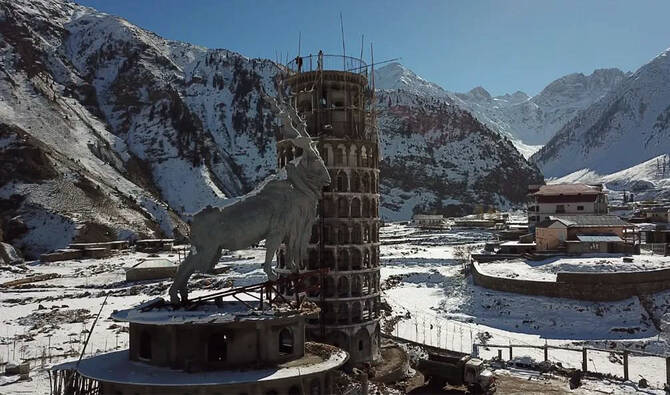
The resort town of Batakundi, in the Kaghan Valley, recently unveiled its newest resident: a massive 105 foot high and 38 foot wide statue of a markhor, Pakistan’s national animal.
Perched on a pedestal next to the Shahdawood Hotel, the new markhor statue took five years to complete, nearly half the time of the hotel itself. It is the largest markhor statue in the world.
“The Kaghan Valley, known for its breathtaking landscapes, now hosts this record-breaking tribute, attracting visitors from across the country and beyond,” Radio Pakistan reported.
What is a markhor?
Markhor are a wild species of goat that live in the meadows and valleys of Central Asia. Of the three major subspecies, the Kashmir markhor is the most populous in Pakistan, with the largest concentration in Chitral National Park. Their horns are wide and flat and have distinctive curls which can grow up to five feet high in males. In ancient Persia, people speculated that markhor gained these curls by hunting down snakes to absorb their power, and so dubbed them markhar, literally “Snake-Eaters.”
Although not endemic to only Pakistan, the markhor’s ability to thrive in seemingly inhospitable terrain has led them to be identified as a symbol of resolve and strength emblematic of the Pakistani people.
Pakistan is reviving the markhor population
Once heavily threatened by overhunting and habitat loss, the Pakistani government has supercharged markhor conservation efforts over the past decade. And their efforts have paid off. The markhor’s International Union for Conservation of Nature’s Red List designation has improved from endangered to near threatened. The country has also raised awareness by establishing May 24 as International Markhor Day at the United Nations.
Batakundi’s markhor statue is a testament to the country’s conservation efforts, and locals anticipate that the massive statue will one day gaze upon a countryside full of its living counterparts.
Photo: The picture shared on November 23, 2025, shows giant Markhoor sculpture on a hotel building in Kaghan. (Shahdawood Batakundi/Arab News)